


The Funding Mirage: How to Cure NPO Mission Drift Before It Ruins Your Non-Profit
Updated: 5 hours ago
In the high-pressure world of South African non-profits, there is a silent killer more dangerous than a budget cut. It usually starts small. An email pings with an alert for a massive, multi-year grant focused on an "Advanced Blockchain AI Data-Internet Gadget.
While innovation is important, haphazardly abandoning your core focus to chase the latest philanthropic trend will leave your organization critically ill.
What is Mission Drift in a Non-Profit Organization (NPO)?
Mission drift occurs when a non-profit organization gradually moves away from its foundational mandate and core objectives in order to secure new funding, appease specific donors, or chase emerging philanthropic trends.
3 Common Signs of NPO Mission Drift:
While a sudden influx of new funding for a trendy project is always tempting, taking on initiatives outside your core mission creates a cascade of negative side effects
Grant Chasing: Applying for and accepting restricted funding for projects that fall completely outside the organization's primary area of expertise.
Resource Dilution: Reallocating essential frontline staff and administrative resources to manage new, unrelated donor-driven initiatives. You are now spending time, money, and administrative overhead on an entirely new sector you have no expertise in, pulling essential resources away from the people you originally set out to help.
Impact Confusion: Measuring success by donor-mandated metrics (like adopting new tech or ESG buzzwords) rather than the actual, tangible social impact on the target community.
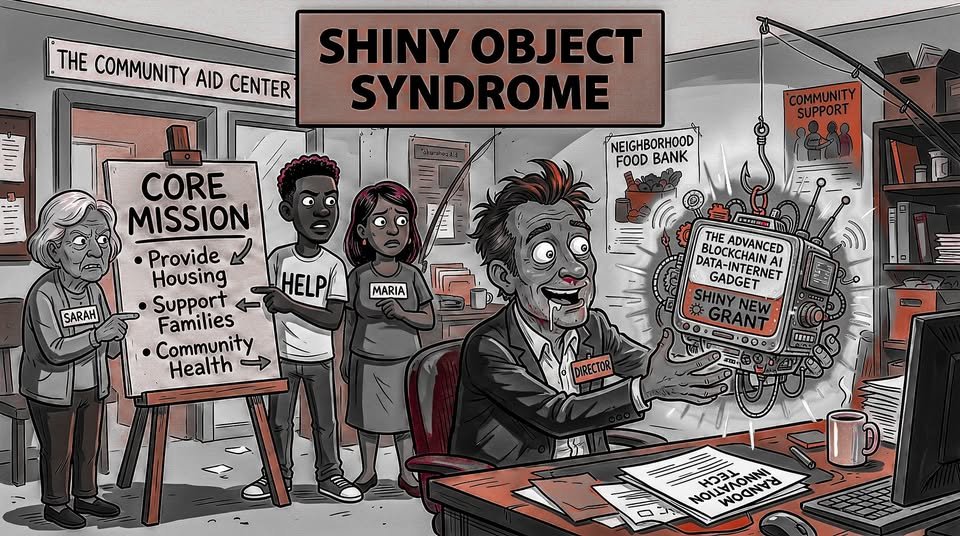
The 2 Satirical (But Very Real) Red Flags of Mission Creep
When an NPO is hypnotized by a shiny new grant, common sense is often the first casualty. Here is what mission drift actually looks like on the ground:
Red Flag 1: The Buzzword Bait-and-Switch
The Original Mission: Tackling essential, on-the-ground community needs like providing housing, supporting families, and improving local health outcomes.
The Mission Creep: An email pings with an alert for a massive, multi-year grant focused on an "Advanced Blockchain AI Data-Internet Gadget." Desperate to capture the funding, the executive director actively begins rewriting the organization’s entire foundational mandate to fit the application criteria.
The Result: The director is left wide-eyed and foaming at the mouth with excitement over tech jargon, completely hypnotized by the shiny new grant. Meanwhile, the frontline staff are left staring at a whiteboard, completely baffled as to how an AI data gadget is supposed to put a roof over a local family's head
Red Flag 2: The Artisanal Soup Kitchen:
The Original Mission: Providing hot, calorie-dense, accessible meals to the downtown unhoused population.
The Mission Creep: The organization accepts a highly restricted grant from a trendy lifestyle brand that mandates the use of locally sourced, organic, hyper-seasonal ingredients to promote "food aesthetics."
The Result: The NPO pivots to offering a "Curated Farm-to-Table Micro-Greens Experience." The core demographic is completely alienated by the deconstructed lentil foam and tiny portion sizes, but the board of directors is absolutely thrilled with the aesthetic Instagram engagement.
The Pathology: Why Does Mission Creep Happen?
Shiny Object Syndrome rarely happens overnight. It usually develops as a symptom of underlying vulnerabilities within the organization:
Severe Financial Pressure: When funding dries up, desperation sets in. Organizations begin contorting their programs to fit whatever grants are currently available, regardless of whether those grants actually serve their target demographic.
A Lack of Strategic Discipline: Without a rigid, board-approved strategic plan acting as an anchor, a non-profit is easily blown off course by every new idea that sounds good in a brainstorming meeting.
Opportunistic Funders: Sometimes the pressure comes from the outside. Major donors or grant-makers may try to push their own pet agendas, dangling large checks in exchange for the NPO taking on projects that dilute its original purpose.
How to Stop Chasing Rands and Start Delivering Results
Curing Shiny Object Syndrome requires strict discipline and a willingness to say "no." Here is how to keep your organization focused on the big picture:
Build a Strong Strategic Plan (And Stick To It): Your strategic plan is your organization's immune system. Before pursuing any new grant or initiative, put it through a strict filter: Does this directly serve the goals outlined in our 3-to-5-year plan? If the answer is no, you pass.
Audit Your Current Programs: Take a hard look at your current initiatives. Are there projects draining resources that don't serve your primary mandate? It may be time to surgically remove them, refer them to partner organizations, or let the funding sunset.
Educate Your Funders: Have confident conversations with donors about what you do and what you do not do. A healthy non-profit partners with funders who align with their mission; it does not change its mission to appease funders.
New funding opportunities will always look shiny. But the organizations that make the deepest, most lasting impact are the ones that have the discipline to keep their eyes strictly on the road ahead. Build a strong strategic plan, secure your core mission, and leave the shiny objects to someone else.


Comments